Countries That Commonly Hire Filipino Workers
Philippines-based, POEA-licensed recruitment agency supporting compliant Filipino manpower deployment since 1990.
Countries That Commonly Hire Filipino Workers are supported by ABD Overseas Manpower Corporation through structured screening, documented processing, and employer-aligned deployment coordination. From Makati City, Philippines, we support workforce mobilization planning across multiple destinations—aligned with Philippine overseas employment standards and employer operational timelines.
Employers use this coverage view to compare common destination markets, plan headcount by region, and anticipate the typical coordination checkpoints that influence shortlist timing and deployment sequencing. Requirements vary by country and role type, so the goal is to give planning teams a clear, practical reference for building realistic mobilization schedules.
To begin coordination, submit requirements via the Request Manpower page. For employer guidance, review the Employers Hub. For broader navigation, use the Countries Hub.
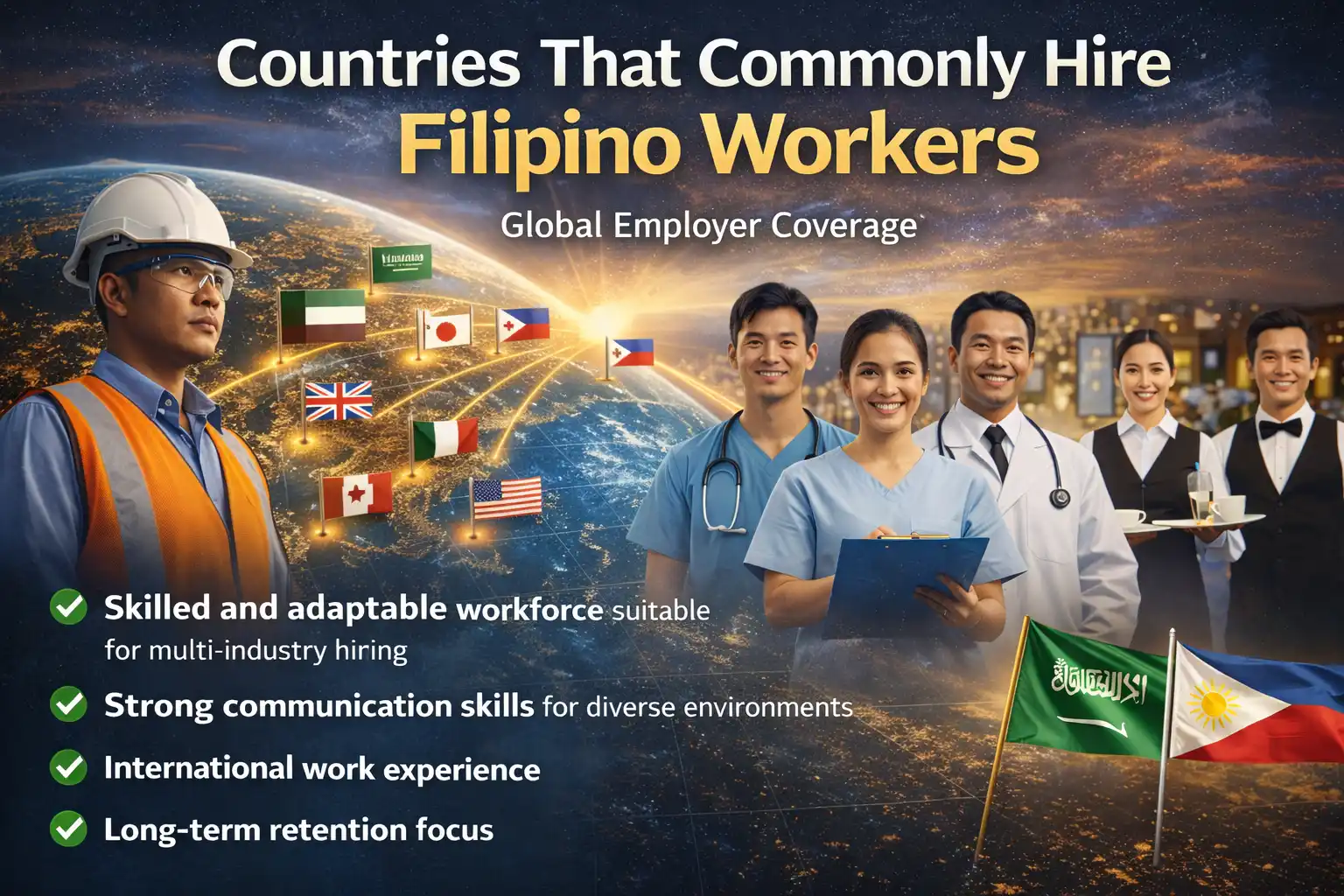
Countries That Commonly Hire Filipino Workers: Global Employer Coverage
This coverage hub groups common destination countries where Filipino manpower is frequently deployed and outlines the employer-side considerations that typically shape lead time, shortlist composition, and document sequencing. Use it as a planning reference for multi-country operations—not as a single universal checklist—because each destination market applies its own approval lanes and role rules.
- Employer planning reference for single-country or multi-country mobilization
- Regional grouping to support faster market comparison
- Compliance-first coordination aligned with Philippine deployment processing checkpoints
- Role and industry fit signals to improve shortlist accuracy and retention outcomes
- Direct internal link paths to country pages and services for execution detail
Where Filipino Manpower Is Commonly Deployed
Filipino manpower is deployed across multiple regions due to strong technical capability, service discipline, and performance consistency in multi-site environments. The groups below reflect common destination patterns used by employers in construction, hospitality, healthcare, logistics, industrial operations, and facilities management.
Gulf Cooperation Council (GCC) Countries
- Saudi Arabia – large-scale project and operations staffing across multiple sectors
- United Arab Emirates – multi-industry staffing with role-specific approvals
- Qatar – project-based demand and regulated processing sequencing
- Kuwait – structured employer accreditation and documentation checks
- Oman – workforce needs across services, industrial, and site operations
- Bahrain – select sector demand depending on employer scope
Explore destination pages where available: Saudi Arabia, UAE, Qatar, Kuwait.
Program-Based and Skills-Verified Recruitment Markets
- Japan – role qualification and program-linked coordination (where applicable)
- South Korea – structured requirements and documented processing checkpoints
- Taiwan – skills alignment and employer documentation sequencing
Skilled Trade, Hospitality, and Healthcare Demand
- United Kingdom – credential alignment for regulated roles
- Germany – qualification recognition and employer compliance requirements
- Italy – sector-led recruitment depending on employer approvals
- Poland – select skilled trade demand depending on employer scope
- Other EU member states – role-specific requirements and licensing checks
Credential-Driven Recruitment for Regulated Roles
- United States – visa program coordination and credential verification
- Canada – employer documentation, credential checks, and role-based approvals
Regional Deployment for Services and Skilled Roles
- Singapore – employer sponsorship and skills alignment
- Hong Kong – regulated role categories and documentation requirements
- Malaysia – employer approvals and processing sequencing
- New Zealand – skills assessment and employer-led requirements
- Australia – role qualification and credential alignment (where applicable)
Sector-Specific Deployment with Worker Protection Controls
- Caregiving and healthcare – sector authorization and controlled recruitment lanes
- Other approved sectors – dependent on documented employer authorization and program rules
Country-Specific Requirements Employers Should Plan For
Destination rules shape lead time, interview scheduling, shortlist readiness, and documentation sequencing. Employers reduce delays by aligning internal approvals, role definitions, and deployment batching before selection events are scheduled.
- Accreditation and principal documentation (market-specific employer eligibility)
- Job order clarity (titles, headcount, salary, worksite conditions, deployment batching)
- Role qualification checks (trade tests, credential validation, language requirements if required)
- Interview and selection protocols (online, onsite, trade test-based, or delegated selection)
- Processing sequencing (documentation, medical, approvals, and deployment scheduling)
- Timeline variance based on destination approvals and employer approval cycles
Detailed Recruitment Execution Workflow
ABD coordinates a structured recruitment workflow for employers managing project mobilization, multi-site operations, expansion planning, and scheduled workforce replacement cycles. The sequence below is built to reduce rework, maintain shortlist discipline, and protect deployment scheduling.
- Employer requirement intake – confirm job titles, headcount, worksite location, salary structure, allowances, target deployment date, and batching sequence.
- Country pathway validation – verify destination market lane (accreditation status, documentation requirements, and host-country checkpoints).
- Role profiling and screening rubric – define skill standards, experience thresholds, trade test parameters (if required), and shortlist acceptance rules.
- Sourcing activation – deploy sector-based sourcing channels aligned to the employer’s role profile and deployment batch sizes.
- Structured pre-screening – validate role fit, experience evidence, worksite readiness, and baseline compliance documentation.
- Skills validation – trade/skills testing or competency verification aligned with the employer’s operational requirements (role-dependent).
- Shortlist packaging – compile profiles in an employer-review format with role alignment notes, test results (if applicable), and availability for batching.
- Employer selection coordination – schedule interviews, trade test observations, or selection review; employer retains final selection authority.
- Selection locking and replacement control – confirm selected names per batch, define alternates, and apply replacement rules to protect timeline.
- Documentation validation sequence – verify identity, employment records, role credentials (where required), and processing completeness before filing.
- Medical coordination – schedule medical steps aligned with destination requirements and batch deployment dates.
- Regulated processing coordination – align submission sequencing and employer documentation requirements with Philippine overseas employment processing checkpoints.
- Deployment scheduling and batching – coordinate flight timing, batch grouping, and employer receiving instructions based on approvals and employer site readiness.
- Post-deployment support lane – maintain employer communication channel for onboarding issues, replacement cycles, and documentation follow-through as needed.
For deeper process context, employers may also review the Step-by-Step Overseas Recruitment Process and our Processing & Placement service page.
Operational Capacity and Coverage
- Years operating: Since 1990 (35+ years)
- Deployment scale range: Single-batch to multi-batch mobilizations (role- and approval-dependent)
- Geographic coverage: Middle East, East Asia, Europe, North America, Asia-Pacific, and Israel lanes
- Execution coverage: Requirement intake → shortlist → interview coordination → processing coordination → deployment scheduling
Mobilization Example
Large mobilizations typically succeed when employers define batching early, lock selection by phase, and apply clear replacement controls. This approach protects site timelines, reduces last-minute changes, and keeps processing sequencing stable across batches.
Recruitment Compliance and Licensing
ABD Overseas Manpower Corporation coordinates recruitment in alignment with Philippine overseas employment regulations and documented deployment processing standards. Country-specific requirements are handled through structured employer documentation and regulated processing checkpoints.
License No. DMW-360-LB-05242024-R
For regulatory reference, visit the Department of Migrant Workers (DMW) .
Employer Paths for Next Steps
- ABD Overseas Manpower Homepage
- Request Manpower
- Contact ABD
- Countries Hub
- Recruitment Services Hub
- Employer Resources Hub
- How to Legally Hire Filipino Workers
- Ethical Recruitment & Compliance
Employer FAQs
Which countries commonly deploy Filipino manpower?
Common destinations include GCC markets (Saudi Arabia, UAE, Qatar, Kuwait, Oman, Bahrain), East Asia (Japan, South Korea, Taiwan), parts of Europe (UK, Germany, Italy, Poland, and other EU markets), North America (US, Canada), Asia-Pacific (Singapore, Hong Kong, Malaysia, New Zealand, Australia), and Israel (sector-specific lanes).
What information should employers prepare before requesting coordination?
Provide job titles, headcount per title, salary and allowances, worksite location, target deployment date, and a batching plan if deployment is phased. This improves shortlist accuracy and reduces revisions.
Do country requirements affect timelines?
Yes. Timelines vary by destination approvals, documentation sequencing, interview schedules, and role qualification requirements. A compliance-first plan should include buffer time for approvals and validation checkpoints.
Who controls final selection?
Employers retain final selection authority. ABD coordinates sourcing, screening, and shortlist packaging, then supports employer-led interview and selection confirmation.
How do employers start?
Submit structured workforce requirements through the Request Manpower page. For clarification before submitting, use the Contact page.