Industries That Commonly Hire Filipino Workers
Philippines-based, POEA-licensed recruitment agency supporting compliant Filipino manpower deployment since 1990.
Industries That Commonly Hire Filipino Workers are supported by ABD Overseas Manpower Corporation through structured screening, documented processing, and employer-aligned deployment coordination. From Makati City, Philippines, our team supports regulated overseas workforce mobilization aligned with Philippine employment standards and employer operational timelines.
This page explains where Filipino manpower is most commonly deployed across global employer demand cycles—and how ABD supports role alignment, testing coordination, documentation sequencing, and deployment scheduling per industry requirements.
Employers may submit requirements through the Request Manpower page, review service coverage in the Recruitment Services hub, or explore employer guidance in the Employers Hub.
Why Global Employers Source Across Multiple Industries
Filipino manpower is commonly deployed in industries where employers need reliable performance, strong communication, and consistent adherence to operational standards. Industry demand typically increases during expansion cycles, peak seasons, infrastructure phases, replacement planning, and multi-site operations requiring stable workforce continuity.
- Operational reliability for shift-based and site-based environments
- Technical competency supported by skills validation and experience matching
- Service and communication readiness for customer or coordination roles
- Workforce stability for longer-term teams and replacement planning
- Employer selection visibility through structured shortlists and interview coordination
Employer Pathways for Industry-Based Recruitment
Use the following pages to plan industry requirements, understand compliant coordination, and submit a structured manpower request:
- ABD Overseas Manpower Homepage
- Request Manpower (job titles, headcount, salary, location, target deployment date)
- Contact (coordination and document checklist support)
- Industries Hub (industry overview)
- Countries Hub (jurisdiction coverage)
- Employer Resources Hub (process and compliance references)
- How to Legally Hire Filipino Workers (employer guidance)
- Step-by-Step Overseas Recruitment Process
Industries That Commonly Hire Filipino Workers
The industries below represent common employer demand categories where Filipino manpower is frequently deployed. Each industry has distinct screening checkpoints—trade validation, experience thresholds, certification requirements, and deployment batching—based on worksite conditions and operational risk controls.
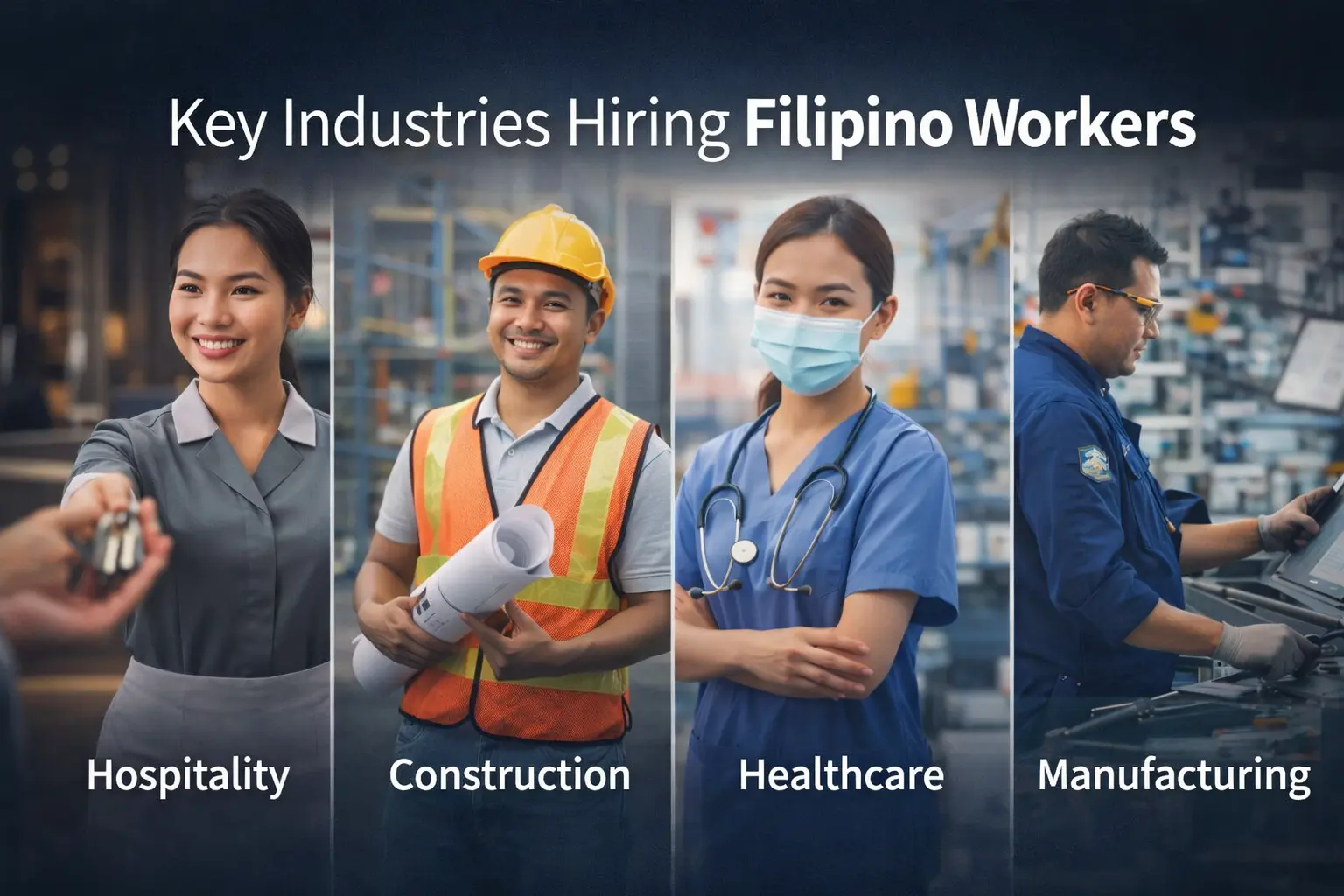
Hospitality and Tourism
Hospitality operations often prioritize guest standards, language capability, and service discipline across hotels, resorts, and food service environments.
- Hotel and resort operations staff
- Food and beverage service teams
- Housekeeping and facilities support
- Front desk and guest services support
Related coverage: Hospitality Recruitment
Construction and Engineering
Construction and engineering employers typically require trade-specific competency, site safety awareness, and the ability to work within schedule-driven project phases.
- Skilled trades (welding, electrical, plumbing, HVAC)
- Heavy equipment operators and site support
- General manpower and supervisors (project-based)
- Engineering support and technical assistants
Related coverage: Construction & Engineering
Healthcare and Medical Services
Healthcare recruitment requires disciplined qualification verification and role alignment with facility standards, licensing pathways, and employer-defined scopes of practice.
- Nurses and nursing assistants
- Caregivers and healthcare aides
- Medical technicians and clinical support
- Facility and patient support roles (as defined by employer scope)
Related coverage: Healthcare Recruitment
Manufacturing and Industrial Operations
Manufacturing environments often require precision, production discipline, and steady performance under quality and safety controls.
- Production and assembly workforce
- Machine operators and line support
- Quality control and inspection teams
- Technical maintenance and plant support
Related coverage: Manufacturing Recruitment
Logistics, Transportation, and Warehousing
Logistics recruitment typically requires experience validation, license or certification checks (where applicable), and safety adherence within supply chain environments.
- Warehouse staff and inventory handlers
- Drivers and delivery support (requirements vary by jurisdiction)
- Dispatch, coordination, and operations support
- Packaging, loading, and staging teams
Private Household and Care Support
Household and care support recruitment depends on employer-defined duties, accommodation arrangements, and clear employment terms approved prior to deployment.
- Household service workers
- Childcare and elderly care support
- Domestic helpers (scope defined by employer contract terms)
- Live-in support roles where applicable
Related coverage: Private Household Recruitment
Office, Administrative, and Support Services
Administrative and support functions are commonly deployed across many industries where employers require coordination capability, documentation discipline, and communication consistency.
- Administrative assistants and coordinators
- Clerical and office support staff
- Customer support and service coordination
- Operations support roles aligned to employer teams
Workforce Categories Supported Across Industries
Role coverage depends on employer requirements, site conditions, and regulatory checkpoints. ABD supports structured coordination for common categories below, with shortlist composition aligned to competency requirements and deployment readiness.
- Trade-specific and technical roles (validated through testing where applicable)
- General workforce and site support for project or operations continuity
- Industrial and facilities support including maintenance and operational helpers
- Service and customer teams for hospitality and support environments
- Administrative coordination roles aligned to employer operational support needs
Industry-Aligned Recruitment Workflow Execution Steps
ABD’s recruitment workflow is structured to reduce avoidable revisions, minimize documentation errors, and improve mobilization sequencing. Execution steps below are adjusted per industry risk level, headcount scale, and deployment schedule.
- Employer requirement intake – confirm job titles, quantity, salary structure, worksite location(s), and target deployment date.
- Role profiling and competency mapping – define trade tasks, tools/equipment exposure, shift patterns, and minimum experience thresholds.
- Sourcing channel activation – mobilize industry-specific sourcing based on trade availability, location, and batching needs.
- Pre-screen interviews – validate role fit, worksite readiness, and communication requirements for employer operations.
- Skills verification – coordinate trade tests or technical checks where required; document results for shortlist visibility.
- Shortlist assembly – curate employer-aligned profiles, filter for readiness, and group candidates by batch if phased deployment is needed.
- Employer interview coordination – schedule interviews, consolidate feedback, and manage selection revisions efficiently.
- Selection confirmation and offer alignment – confirm selected names against approved terms, allowances, and site conditions.
- Documentation validation – verify identity and supporting documents; align data fields to reduce processing rework.
- Medical and readiness checks – coordinate required evaluations and track completion status for deployment scheduling.
- Regulated processing coordination – sequence employer and worker documents for compliance-aligned processing checkpoints.
- Deployment batching and mobilization – schedule deployment per employer timeline, including phased batches and replacement cycles.
- Post-deployment coordination support – maintain communication for workforce continuity, replacement planning, and documentation follow-through.
Indicators for Employer Planning
Employers often require baseline indicators to plan mobilization capacity, timing, and coverage. The figures below are presented as planning inputs, with final timelines dependent on role complexity, employer interview scheduling, and processing requirements.
- Years operating: Established 1990 (35+ years of overseas manpower coordination)
- Deployment scale range: Single-role hiring up to multi-trade, batch-based mobilization (headcount varies by project scope)
- Geographic coverage: Supports licensed international employers across common destination markets via structured processing coordination
- Industry coverage: Construction, hospitality, healthcare, manufacturing, logistics, household support, and administrative support
For employer planning, you may also review: Industries Hub and the Countries Hub.
Mobilization (Operational Reference)
Supported multi-phase mobilization for infrastructure contractors requiring phased deployment of 150+ skilled workers, with trade testing, shortlist batching, and deployment scheduling aligned to site ramp-up milestones.
Recruitment Compliance and Licensing
ABD Overseas Manpower Corporation coordinates recruitment in alignment with Philippine overseas employment regulations and documented processing standards. Employer requirements, candidate selection, and deployment steps are structured to maintain audit-ready documentation and controlled sequencing.
License No. DMW-360-LB-05242024-R
For regulatory reference, visit the Department of Migrant Workers (DMW) .
Employer FAQs
Which industries can submit requirements to ABD?
Employers across hospitality, construction, healthcare, manufacturing, logistics, household support, and administrative support may submit requirements through Request Manpower.
How do employers improve shortlist accuracy?
Provide job titles, headcount, salary structure, worksite location, experience thresholds, and a target deployment date. Clear inputs reduce revisions and improve batching.
Who retains final selection authority?
Employers retain full selection authority following shortlist review and interview coordination.
How do you manage trade-specific requirements?
Trade roles are aligned through competency mapping and skills verification steps, then documented for employer visibility before selection confirmation.
Can recruitment be phased by batch?
Yes. ABD supports batch-based mobilization aligned with project ramp-up schedules and replacement cycles, subject to screening readiness and processing sequencing.